Poultry products follow a common pattern with the products of other industries in line with technological advances and mechanization. What has caused this huge change in the field of poultry farming is the emergence of automatic feeders. Soon after the invention of incubators, the number of chickens increased and this increased the need for feeders. Using manual feeders was much more costly and time-consuming, the automatic feeder system overcomes all these problems.
Introducing Automatic Dance
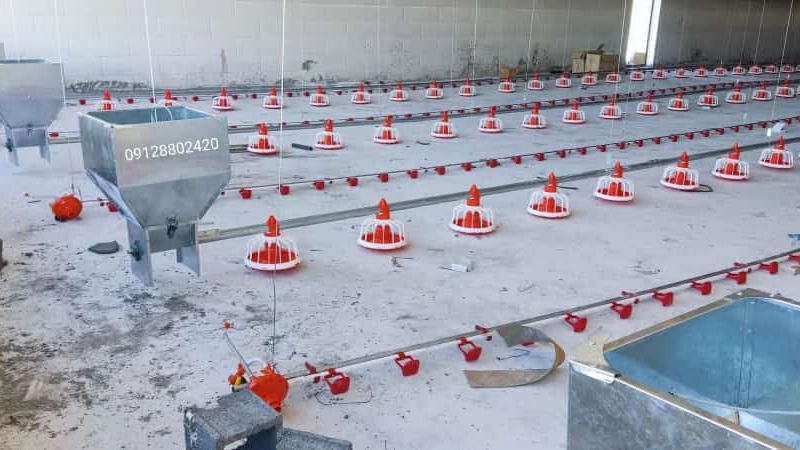
Automatic feeders have a large funnel-shaped tank called a hopper, which is responsible for providing bird feed throughout the day. This process must be repeated several times during the day, but for automatic feeders, the story will be completely different. In automatic feeders, chicken farmers are required to fill the hopper (funnel-shaped tank) only once during the day and the rest The work, including spreading manure and supplying manure until the end of the day, will be the responsibility of the automatic feeder.
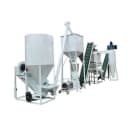
A complete set of automatic feeders includes the following items: >Dan transfer system
Dan discharge system
Automatic
The feeding and feeding system inside the hall includes a spring, pipe, hopper, feeding plate, as well as a capacitive optical sensor or microswitch. The sensor for grain transfer in the hopper and in the Ogri feeding line is generally installed in the bottom of the last plate located at the beginning of the line. This sensor is connected to the electrical panel and as soon as the plate at the beginning of the line with the sensor is full, it turns off the motor of the grain distribution system and The transfer of manure from the hopper to the feeders is stopped.
Whenever the floor of the sensor feeder is empty of manure, the command is given to the panel to restart the manure distribution system.
Now a question may arise if Chickens are available What if they finish the feeder with the sensor faster than the rest of the feeders? In this situation, it is possible to define a schedule to prevent the manure distribution system from being used again when the rest of the feeders still contain manure. For example, whenever the completion message is received from the sensor, the distributor engine is turned on 4 hours later.
The grains in the silo are discharged through the lifting pipe installed at its lower end. The task of transferring manure from the hopper to the feeders is the responsibility of the manure transfer spring.
After the last grain transfer hopper is filled, the transfer device stops automatically. After all the feed is eaten by the chickens, the conveyor hopper automatically enters the emptying phase and the feeders are recharged.
The benefits of automatic eating
Today, automatic feeder systems create high profitability for poultry farmers.
Automatic feeders can be used for chickens, broilers, laying hens, mother hens and even adult turkeys.
In this method, it will be possible to fully regulate and control the amount of feed consumed.
Chickens naturally consume less feed than chickens. Therefore, with the help of the automatic system, you can change the amount of feed to the feeder as you wish. An automatic feeding system has more control and can adjust the speed of the spring rotation. Among other advantages provided by This automatic system is offered is that you can program the device to turn on or off for different time intervals. The biggest advantage of this system is saving money. Many users claim that this system can pay for itself within one or two years by optimizing energy consumption.
Other advantages of this system are the need for less manpower, because the full system Feeding is done automatically. So, there is no need for human labor to fill the feeder with bags of manure every day.
The low wastage of pellets and the desire of birds to eat pellets due to the movement of the chain are other advantages of this system. . Because the feeders in the automatic system are placed at a standard height and fixed to the rod, it minimizes the possibility that the chickens hit the feeders and the possibility of dropping the grains out of the container.